No Stage, No Mic, No Escape: The Barbershop Became Rap's Last Honest Room
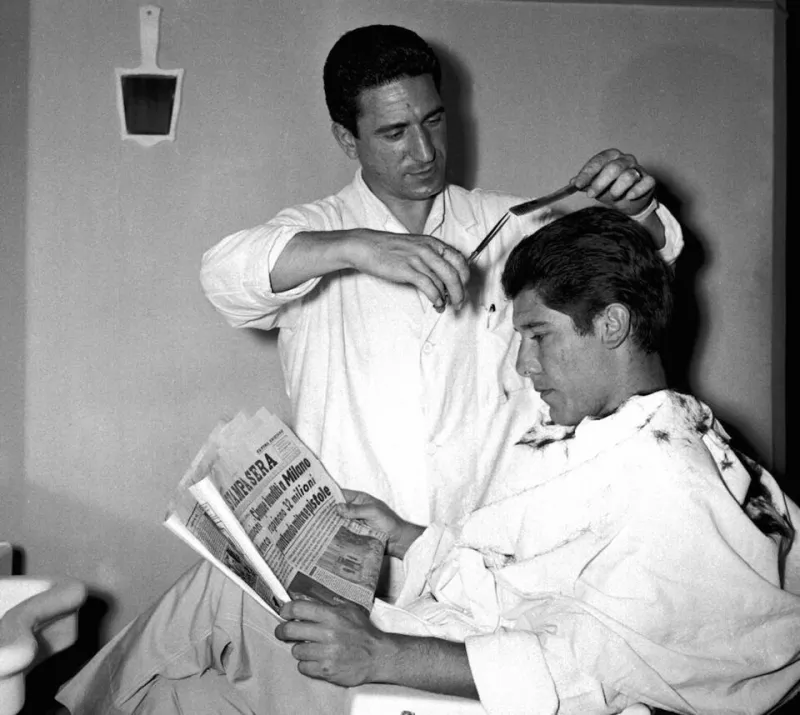
Photo: Juventus Historical Archive / LaPresse, Public domain, via Wikimedia Commons
There's no green room in a barbershop. There's no soundcheck, no door list, no promoter texting you about set times. There's a chair, a mirror, a pair of clippers humming, and whatever comes out of your mouth when somebody points a phone at you and says, "Yo, you claim you nice — let's hear it."
That's the whole audition. And lately, that audition is the only one in hip-hop that can't be faked.
The Fade Heard Around the Feed
Scroll long enough on any platform and you'll hit it: a guy halfway through a taper, client spun around in the chair, spitting sixteen bars with the cape still on. The barber nods on the two and the four while working the lineup. Comments section losing its mind. Three million views by the time the taper's done.
This isn't a trend some marketing agency cooked up. It's a resurrection. The barbershop cypher never actually died — it just went unrecorded for thirty years. Old heads will tell you the shop was always the listening room, the debate hall, and the open mic wrapped into one. What's changed is that now every shop has a tripod in the corner and every client has a platform in their pocket.
What hasn't changed is the standard. And that's the point.
Three Chairs, Three A&Rs
Talk to the barbers running the busiest shops in this lane and a pattern shows up fast: none of them asked for this job.
In Atlanta, a shop on the Southside has become a mandatory stop for any artist bubbling in the metro. The barber there — let's call him what his clients call him, the filter — has a simple rule: if you can't rap while he's cutting and the whole shop is watching, you can't rap. Period. He's turned down guys with real budgets and real buzz because they folded the second the clippers stopped. The clips he posts carry weight precisely because everybody knows he doesn't post everything.
In Detroit, the scene runs colder and so does the room. A shop off Gratiot has become famous for the pause — the barber keeps cutting, doesn't react, doesn't nod, and lets the silence do the judging. Rappers say getting a head nod out of that chair is harder than a co-sign from a label. The clips that leave that shop feel earned because the room's default setting is skepticism.
And in the Bronx, where this whole culture started, a third-generation shop treats the cypher like church. Elders in the corner grade the freestyle against fifty years of history. You're not just rapping for the phone — you're rapping for the men who've heard every style come and go since the seventies. Survive that room and the internet is easy.
None of these men take a percentage. None of them have management deals. They cut hair. The A&R thing happened to them because they're in the one room where everybody in the neighborhood passes through eventually.
Why You Can't Hide in the Chair
Here's the argument, plain: the barbershop is the last venue with no production to lean on.
A live show has a stage, lights, a hype man, a crowd that came to have fun. A studio has punch-ins, tuning, forty takes. A TikTok has filters, loops, and editing. Every one of those settings lets a rapper manage the gap between what they are and what they appear to be.
The barbershop closes that gap. There's a beat — maybe, if somebody's phone speaker is up. There's background noise: clippers, conversation, a game on the TV. There are people standing three feet away who know every rapper in the city and can smell a written-from-Google verse in four bars. And there's no cover charge, which means nobody in the room is pretending to be entertained. If it's wack, they go back to their conversation. That's the review.
The client in the chair has it even harder. He can't pace, can't roam, can't hide behind ad-libs. He's stuck there, eye to eye with a mirror full of witnesses, cape on, mid-haircut. It's the most exposed a rapper can be without being on a polygraph.
The Pipeline Nobody Charges For
Compare this to the rest of the industry's front doors. Pay-to-play showcases charging artists for "exposure." Playlist placement brokers quoting four figures. Open mics with featured-performer slots you can buy. Every official entrance to the industry now has a toll booth on it.
The barbershop is free. The barber doesn't want your money for the clip — he wants content for the shop page and bragging rights for the block. The artist doesn't owe a split. The audience isn't captive. It's the only remaining lane where the only currency is actual ability.
And labels have noticed. A&R reps are DMing barbers now. Some shops have quietly shipped talent to sessions and label meetings. The beautiful part is that the shops don't need it to work out. If the industry never calls, the cypher still runs every Saturday like it has for decades. The barbers aren't chasing anything. They're just documenting what was already there.
Keep the Chairs Honest
There's a risk, of course. The moment a barbershop clip becomes a known co-sign, people will start staging them — planted clients, rehearsed "freestyles," the whole thing laundered into another content farm. Some of that is already happening, and the audience can smell it. The clips that hit hardest are still the ones where the shop keeps talking in the background, where somebody laughs at the wrong moment, where the barber never stops cutting.
That mess is the authentication. Strip it out and you've got another studio performance with better set dressing.
So the word to artists is simple: pull up to the shop. Not to film — to get a haircut. Let the cypher find you. And the word to everybody else: when you see that clip of a man rapping with a cape on and a fade half-done, understand what you're watching. That's not content. That's the last room in America where a rapper has to be exactly who they say they are.
The clippers don't lie. The mirror doesn't lie. And neither does the chair.