Roll-Up Doors and Packing Blankets: The Storage Unit Studio Boom Nobody Planned
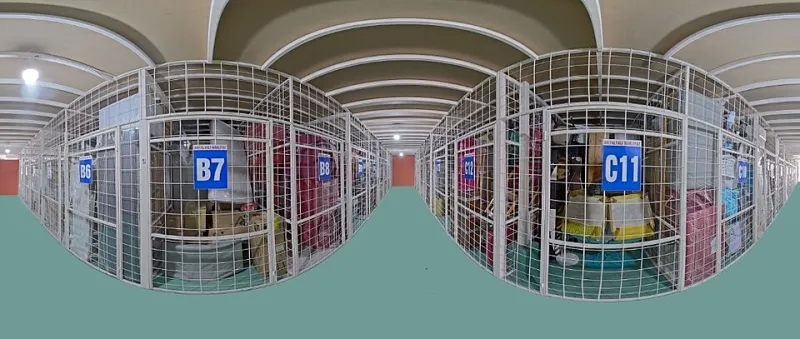
Photo: KafesDepo, CC0, via Wikimedia Commons
The first thing you notice is the smell. Concrete, dust, and whatever the last tenant left behind. The second thing is the bass. Somewhere down the corridor, behind a door that looks exactly like every other door, somebody's running a session. You'd never know it from the street. That's the whole point.
Why a Roll-Up Door Beats a Real Studio
A real studio charges by the hour, and the hourly rate attaches judgment to every take. You feel it at minute forty when the verse still isn't landing and the clock is the loudest thing in the room. A storage unit charges by the month. Sessions stop revolving around the meter and start revolving around whether the take is good.
The other draw is control. No front desk, no waiting room, no engineer sighing at 1 a.m. because you want to run the hook eleven more times. You lock in, you plug in, you leave when you're done. For a lot of self-recorded rappers, that privacy is worth more than any console.
The Math: Sixty to Two Hundred a Month
Pricing varies by market and unit size, but the sweet spot is a 10x10 or 10x15 at a facility with 24-hour gate access and month-to-month terms. That's cheaper than almost any commercial room in America by a factor of ten, and it beats the bedroom if the bedroom has family, roommates, or thin walls.
Most people splitting a unit are doing it with two or three others — a rapper, an engineer, and somebody who owns a decent interface and needs somewhere to keep it. Rent gets divided. Gear gets locked in a cabinet bolted to the floor. Nobody's building equity, but nobody's going broke either.
Blankets, Foam, and the Myth of the Egg Crate
Storage units are concrete boxes with metal doors, which means they ring like a drum and leak sound like a sieve. The standard solution is moving blankets and packing blankets hung on rails or stapled along the walls, a rug or carpet remnant on the floor, and a corner rigged out of PVC pipe and heavy fabric for vocals. Cheap foam panels help with reflections. Egg crates do almost nothing except make the room look like a dorm.
Some people go further — a panel-on-stands setup they can break down in five minutes, a door seal made of weatherstripping, a towel taped around the mic. It's not acoustically perfect. It doesn't need to be. It needs to keep the vocal dry and the neighbors calm.
The Neighbors Behind the Doors
Here's what nobody tells you about storage facilities: they're not empty. There's a guy two doors down with a vinyl setup. There's a woman running a nail business out of a unit with a folding table and a ring light. There's a woodworker, a reseller, a guy who restores bikes, and a whole family of plastic bins labeled Christmas.
That accidental proximity builds community. People trade extension cords. Somebody always knows somebody who mixes. A rapper and a producer who meet at the gate at 2 a.m. have started more projects than any industry mixer ever has. The corridor becomes a hallway, and the hallway becomes a scene.
What Can Go Wrong
Plenty.
- Lease terms. Most facility contracts are written for dead storage, not commercial use. Recording is often technically against the rules. Read the paperwork before you hang a single blanket.
- No climate control. Summer turns a unit into an oven, and heat is the enemy of hard drives and tempers alike. Interior units stay cooler than exterior ones.
- Water. Check for ceiling stains and drainage before you sign. One good storm ends careers and equipment in the same afternoon.
- Security. Gate codes get shared, and gate codes get leaked. Insure the gear or accept that you might not see it again.
- Fire code. Extension cords daisy-chained across three power strips is how people lose everything. Get a real surge protector and don't run a space heater next to a blanket wall.
The House Rules
Every good unit has an unwritten code. Don't slam the door — the metal echo kills takes three rooms over. Keep the bass reasonable after midnight. Don't leave trash in the corridor. If you're splitting the unit, split the key code, split the rent, and write down who owns which mic. And when someone's rolling a verse at 3 a.m. and the take is finally landing, don't knock.
Nobody's going to put a plaque on a storage facility. The music industry doesn't know these rooms exist. But if you want to hear what a city actually sounds like right now — not the version that made it through a mix engineer's three-week queue — go find a facility with a rolled-down door and a light on underneath it. That's where the records are.