Follow the Receipts: Rap Beef Is a Business Model Now and Everybody's Cashing Out
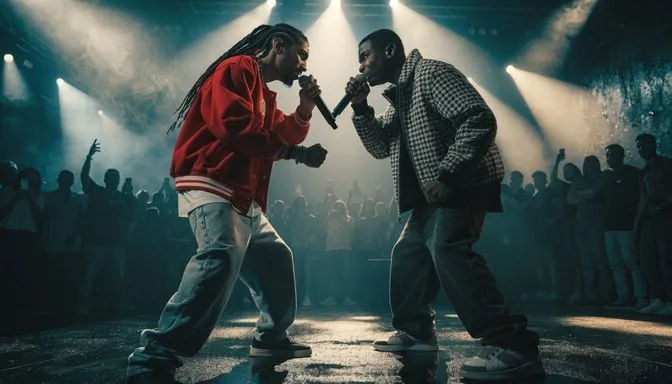
Photo: rap battle two rappers face off microphone dark stage, via images.stockcake.com
Nobody Ducks Anymore Because Nobody Has To
There was a time when a real beef meant real consequences — lost friendships, lost shows, sometimes worse. Now it means a spike in monthly listeners, a merch drop timed to the third diss, and a booking agent raising the quote by forty percent.
I'm not saying artists aren't serious. I'm saying the seriousness has a revenue line attached. Modern rap beef is less street and more spreadsheet, and if you can't see the spreadsheet, you're the audience, not the player.
The Anatomy of a Profitable Feud
Look at how the big ones actually played out and the pattern is hard to miss:
Phase one: The soft launch. A subliminal bar in a verse, a podcast comment clipped and uploaded by a fan account. Zero risk, maximum plausible deniability. This is the free trial.
Phase two: The escalation. A direct diss drops, usually a full song, usually on streaming at midnight. The other artist's catalogue streams jump within hours — not just the diss records, the whole catalogue. Casual listeners go back and re-litigate discographies. Nobody planned for this in 1995. In 2024, it's the entire point.
Phase three: The monetization. Tour dates get "upgraded to arenas." A surprise album drops mid-beef because the attention window is open and it might never open again. Merch with the diss punchlines hits the store. Podcast appearances get booked at peak rates.
Phase four: The settlement. Sometimes it fizzles. Sometimes there's a détente. Either way, both parties walk away richer in attention than they started, and attention is the only currency that converts to everything else.
Who Cashes In — And Who Gets Played
Here's the part that should make you uncomfortable: the biggest winners in most modern beefs aren't either artist. It's the platforms.
- Streaming services get a guaranteed engagement spike with zero risk. Every diss track is free content marketing for their subscription model.
- Podcasts get clip-able drama for weeks. The call-out episode outperforms the music episode every single time.
- Ticket resellers watch demand surge on both tours simultaneously.
- Merch operations — some of these drops are planned weeks in advance. If the punchline shirts arrive suspiciously fast, that's not speed. That's scheduling.
The artists? One wins the battle, both win the quarter. The fans get played the hardest — we supply the engagement that pays for the whole operation and we do it for free, arguing in comment sections at 2 a.m.
When the Conflict Is Manufactured, What's Left of the Truth
I want to be fair here, because the counterargument is real: battle culture is founding hip-hop culture. The dozens, the ciphers, the Roc-A-Fella vs. Nas era — competition built this art form. Diss records have produced some of the greatest music in the canon. Nobody's mad about competition.
The problem is the difference between competition and content.
Competition happens between artists with something real at stake — reputations, legacies, neighborhoods. Content happens between brands with something financial at stake. And audiences can smell the difference even when they can't articulate it. That's why a genuinely personal beef still hits different: the bars are sharper, the stakes feel heavier, the whole thing feels load-bearing.
When every feud has a merch drop attached, we train the next generation that conflict is a marketing channel instead of a consequence. That's not street truth. That's street theater, and theater has a running budget.
The Grind Test
Here's my rule of thumb for reading any beef in 2025: follow the receipts.
If the conflict costs somebody something — a friendship, a reputation, a real risk — it's probably real, and it's probably going to produce great music.
If the conflict makes everybody money the moment it starts, ask yourself who's holding the camera.
The grind is real. The hunger is real. But the next time two millionaires start trading subliminals on a Tuesday, don't ask who's winning. Ask who's invoicing.